PROTEIN STABILITYPrecision Analysis, Accelerated Discovery
Protein Conformational Stability, Cold Denaturation and High-Pressure Study
Protein conformational stability is governed by a small folding–unfolding free-energy difference, often only on the order of a few kcal/mol. Because that margin is narrow, proteins can be sensitive to temperature, pH, ionic environment, pressure, cosolutes, and interfaces. A useful way to frame the field is that heat denaturation and cold denaturation are two limbs of the same stability curve: high temperature can drive unfolding through increased conformational entropy and weakened hydrophobic stabilization, whereas sufficiently low temperature can also destabilize folded structure through changes in hydration and heat-capacity effects. Importantly, the intermediates populated on the cold and hot limbs need not be identical; partially folded or "molten-globule-like" states may be especially relevant near cold-denaturation conditions.
SophiSta
The SophiSta System enables multi functional, multi dimensional analysis of conformation, particle size, aggregation status and other comprehensive properties for proteins, antibodies, vaccines and adjuvants, nano protein particles, virus like particles, AAV and other biologic products under both elevated temperature and sub zero operating modes
View Details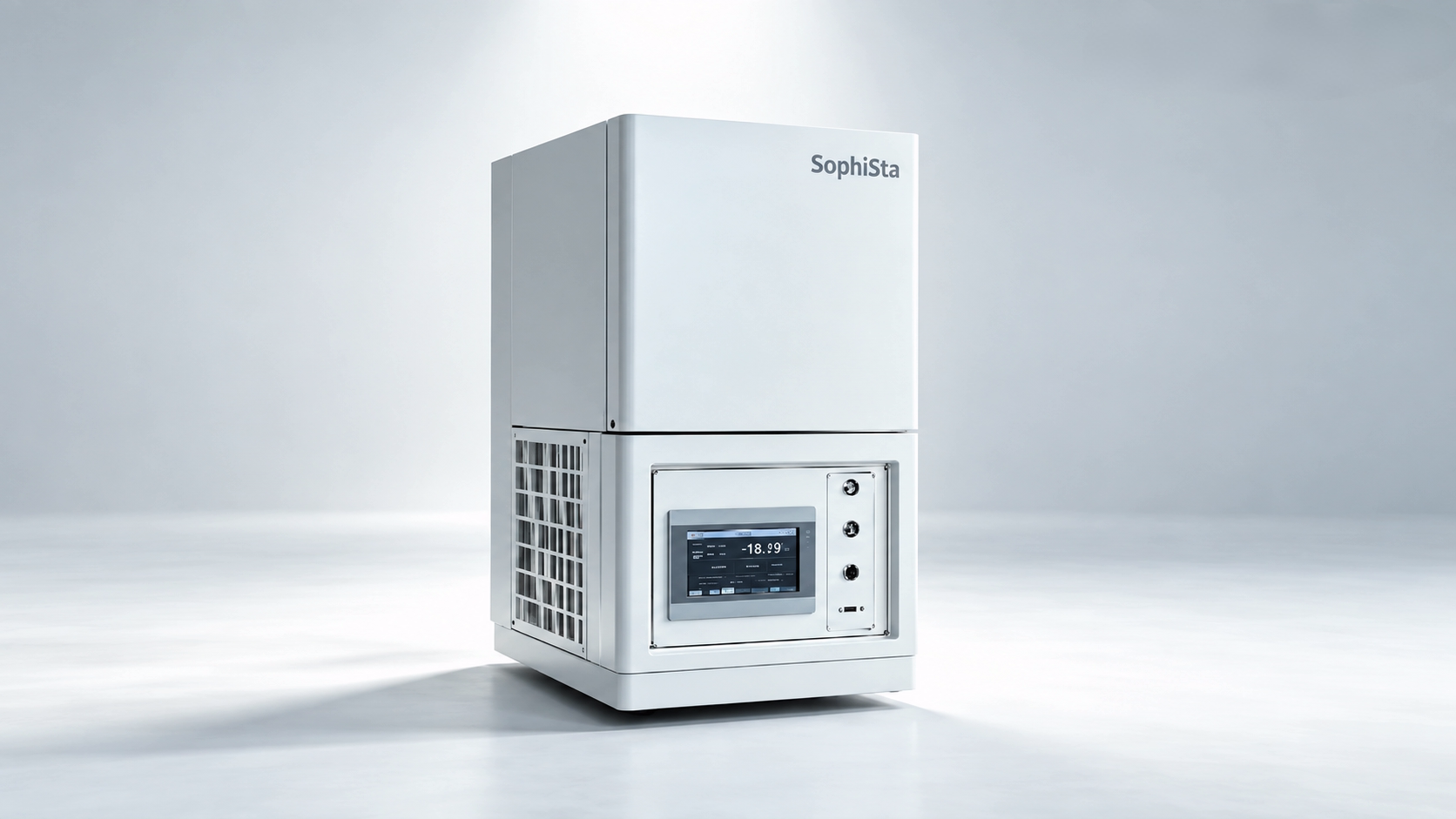
Application
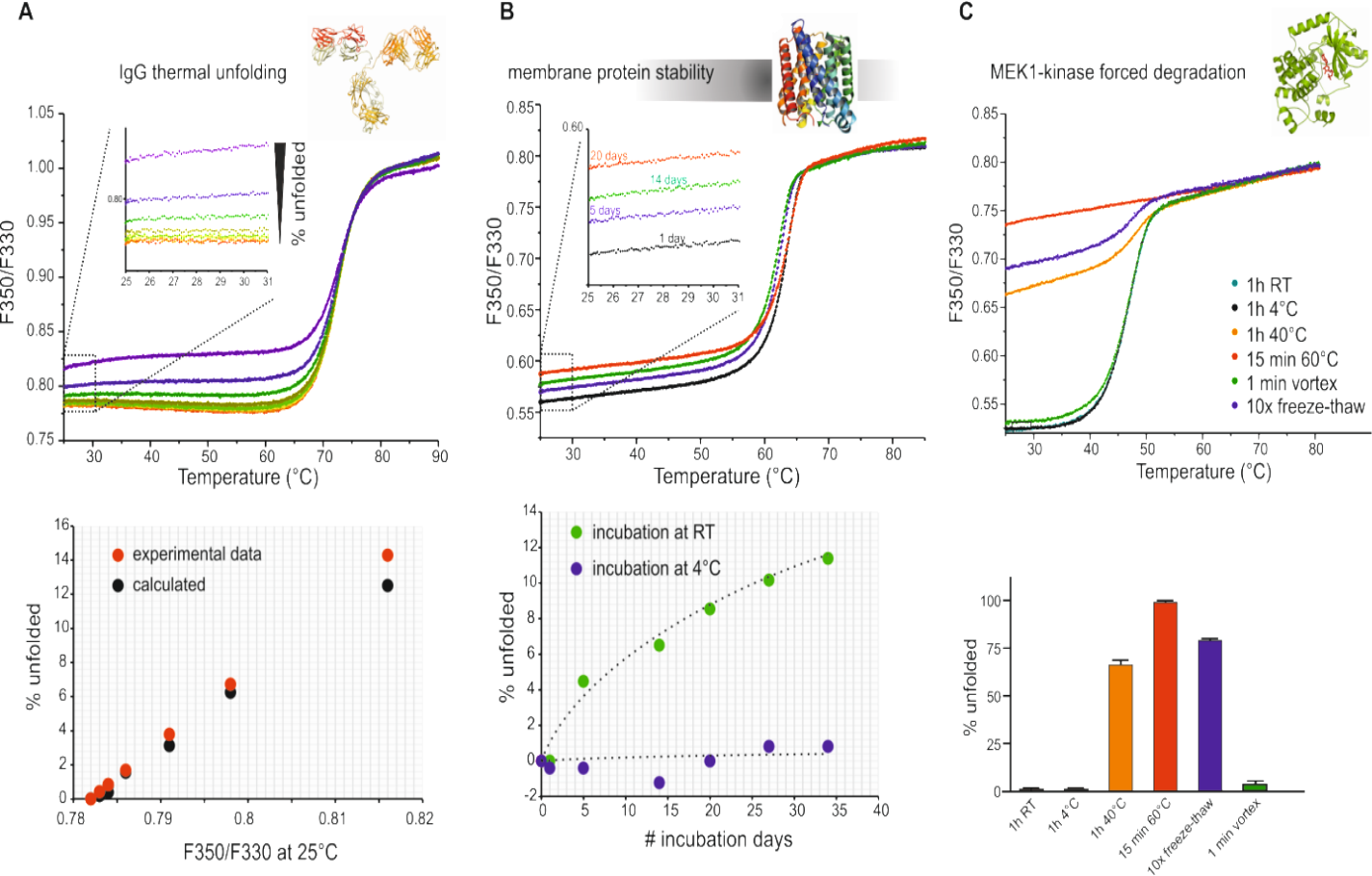
Figure 2
Protein Unfolding Analysis
A) Establishing a protein unfolding standard. Unfolded IgG at different concentrations was mixed with folded IgG and subject to thermal unfolding. The percentage of unfolded IgG in the solution was quantified based on the F350/F330 ratio measured at 25 °C. B) Long-term storage test on HiTeha. Aliquouts of the integral membrane protein HiTeha were stored at 4 °C and at RT, respectively, and thermal unfolding curves were measured over a time period of 34 days. %unfolded protein was calculated based on the F350/F330 ratio. C) Forced-degradation stress-test on MEK1. MEK1 protein was subject to the indicated stresses, and the fraction of unfolded protein was calculated based on the F350/F330 ratio at 25 °C. Error bars are s.d. from three measurements.
Learn More