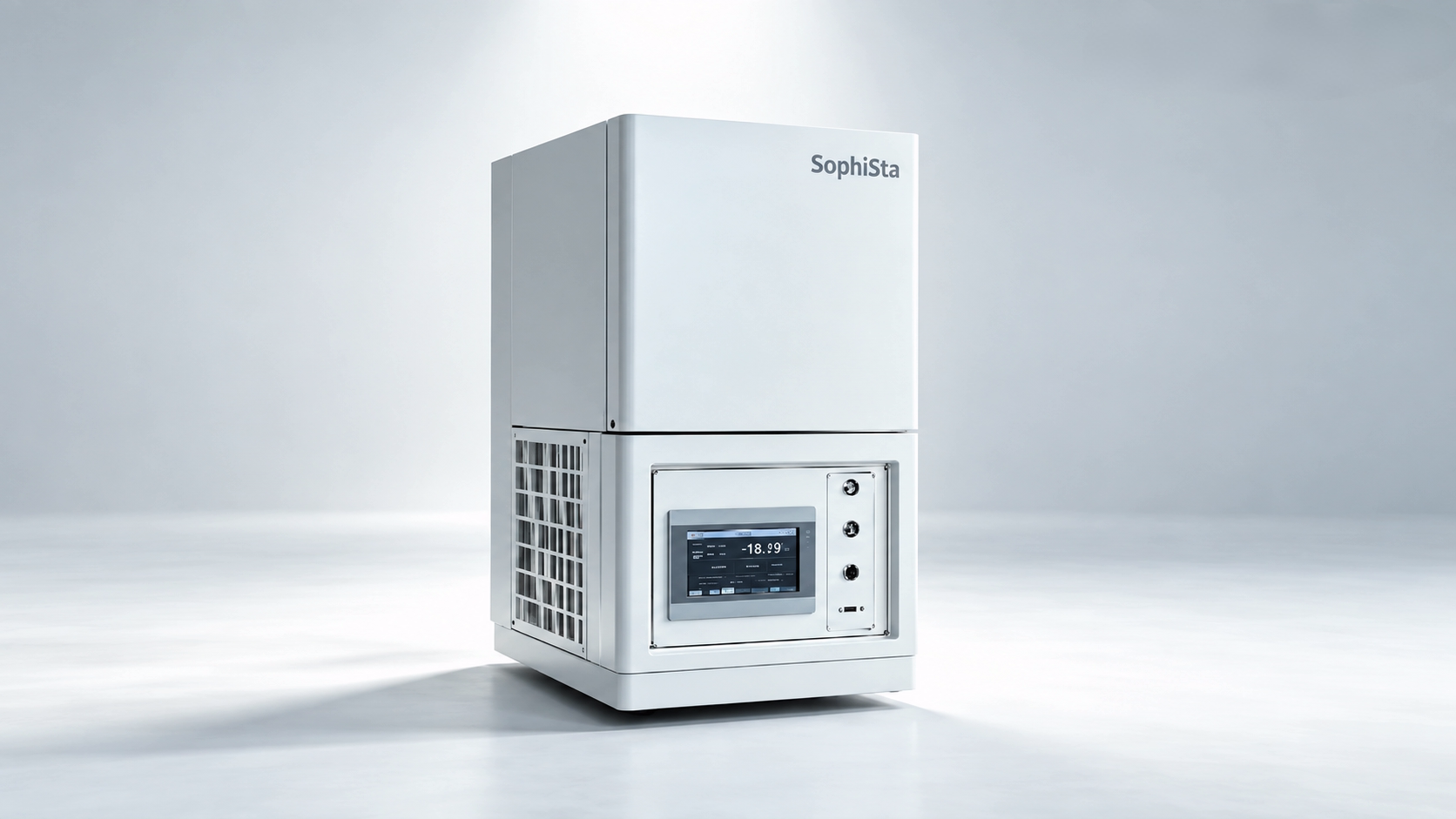
SophiSta
SophiSta System
The SophiSta System enables multi functional, multi dimensional analysis of conformation, particle size, aggregation status and other comprehensive properties for proteins, antibodies, vaccines and adjuvants, nano protein particles, virus like particles, AAV and other biologic products under both elevated temperature and sub zero operating modes. It supports developability assessment, analytical quality control, long term stability evaluation, exploration and optimization of storage and transportation conditions for diverse biologic entities. It can also be applied to basic research in biomedicine and life sciences for investigating structure function relationships.
Evaluating formulation stability is critical for sensitivity that may impact biological activity, product safety and quality. Assessment of low temperature stability is also essential; however, limited methodologies combined with slow degradation kinetics make it difficult to collect experimental data under cold conditions. The SophiSta System delivers an approach to perform both high temperature stability studies to 95℃ and accelerated isothermal stability studies below 0 °C without ice formation, for example to elucidate protein aggregation mechanisms and the efficacy of selected cryoprotectants.
- ▶Perform accelerated isothermal stability studies below 0 °C under ice free conditions to clarify degradation mechanisms associated with cold denaturation or phase transition.
- ▶Directly assess the influence of low temperature on active molecule stability, avoiding uncertainties introduced by modelling extrapolation from high temperature data.
- ▶Predict low temperature stability of formulations within days instead of months.
Sub-zero Ice Free Stability Studies
Accelerated stability studies are almost indispensable for early stage assessment of protein stability. Conventionally, acceleration is achieved by elevating temperatures 40 °C or higher above refrigerated conditions, to circumvent the slow kinetics that would require months or years under real world storage. Nevertheless, high temperature approaches often lead to oversimplified interpretation that "the lower the temperature, the more stable", and consequently overestimate storage stability under refrigerated or frozen conditions.
Protein aggregation can be considered a two step process: first, particles must come into contact; second, complex formation takes place. While the first step (collision frequency) decreases with cooling, the second step (complex formation) is enhanced by protein unfolding. Aggregation mediated by unfolding is therefore expected to reach a minimum near the temperature of maximum stability (TMS). Below TMS, unfolding increases exponentially upon cooling via cold denaturation, which accelerates unfolding driven aggregation. This principle underpins the low temperature stability accelerator, favoring reactions mediated by phase transition at sub zero temperatures.
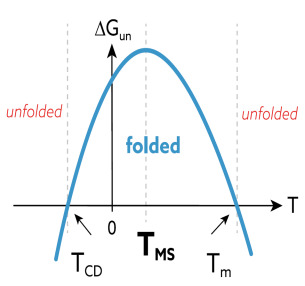
Figure 1. Gibbs free energy of unfolding ΔGun as a function of temperature, showing maximum stability at TMS between melting temperature Tm and cold denaturation temperature TCD. Beyond these two temperatures (above Tm or below TCD), the unfolded state is thermodynamically favored.
Formulation Product Optimizations
The SophiSta System employs stainless steel vials under isochoric conditions to limit volume expansion of ice crystals, suppressing ice crystal growth upon cooling below 0 °C. This prolongs protein unfolding and accelerates aggregation kinetics, enabling evaluation of temperature and cryoprotectant effects on formulations within days.
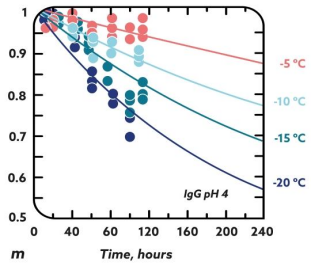
Figure 2. Unfolding mediated aggregation example for IgG at 100 g/L; aggregation rate increases as temperature decreases.
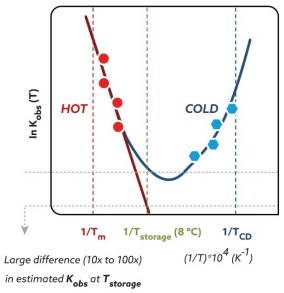
Figure 3. Classical modelling using only high temperature data (red) versus modelling incorporating low temperature measurements (blue). The red straight line illustrates large extrapolation uncertainties in estimating kobs for refrigerated storage conditions without data from this system.
system extends classical high temperature based methodologies by capturing protein low temperature kinetics. This enables building models over a much broader temperature window spanning from TCD to Tm, removing uncertainties originating from temperature extrapolation.
Improving Protein Low Temperature Stability
Cryoprotective excipients are commonly used to mitigate protein degradation; understanding their protective effects under cold conditions is of high importance. Figures 4A and 4B demonstrate sucrose mediated protection: higher sucrose concentrations retain higher monomer fractions under stress. A linear correlation is observed between sucrose concentration and aggregation rate measured via kobs (Figure 4C).
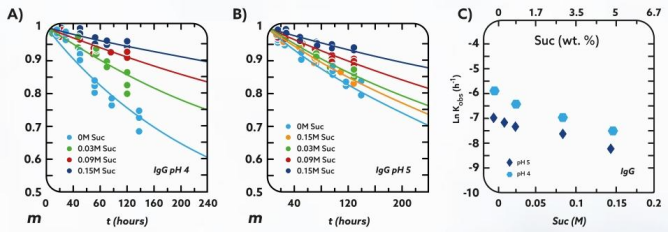
Figure 4. Monomer loss kinetics under isochoric conditions at −20 for several sucrose concentrations (A and B). Panel (C) plots the apparent rate coefficient kobs as a function of sucrose concentration.
Low Temperature Stability Assessment
This case study evaluates low temperature stability beyond conventional accelerated tests that rely on high temperature data and mathematical models such as the Arrhenius equation. Isochoric cooling methodology was applied to measure antibody aggregation rates across a broad temperature range (−25 °C to 60 °C) while preventing ice formation below zero.
Results show that isochoric methodology captures aggregation timescales and distinguishes between "native" and "unfolding driven" mechanisms at low temperatures. For mAbs, native state driven aggregation (NN mechanism) dominates between 5 °C 25 °C typical storage conditions, transitioning to unfolding driven mechanisms including cold denaturation under sub zero frozen relevant conditions.
In summary, this methodology enables simulation of aggregation rates at refrigerated storage (5 °C) within a relatively short experimental timeframe (1 2 weeks).
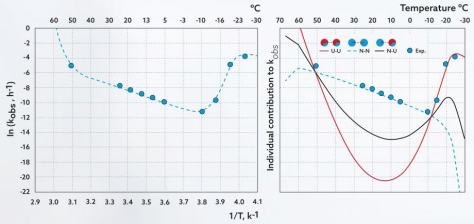
Figure 5. Arrhenius type plot of ln(kobs) for mAb B calculated via the NN model, with thermodynamic parameters fitted for the U model (fs=0.6%). Left: predicted kobs; Right: individual pathway contributions to predicted kobs.
Full Spectrum Detection
Biologic proteins exhibit highly diverse behaviours in formulations. The SophiSta System acquires real time dynamic full range fluorescence spectra under high temperature operating mode. Spectra can be dynamically re played after experiments to verify protein denaturation processes and derive Tm values. No dye labelling is required. It is compatible with diverse buffer conditions and can measure membrane proteins in detergent containing environments. Aggregates are detected at two laser wavelengths, 266 nm and 473 nm, regardless of aggregate particle size.
Multi Dimensional High Temperature Stability Information
How to investigate new formulation candidates or protein constructs? The SophiSta System completes measurement and analysis for up to 48 samples within approximately two hours. High throughput multi parameter screening streamlines formulation development. Melting temperature Tm from intrinsic fluorescence and aggregation onset temperature Tagg from static light scattering (SLS) are acquired simultaneously to comprehensively characterise protein denaturation and aggregation upon heating. DLS measurements can be performed before and after thermal ramps to confirm aggregate formation.
High Temperature Isothermal Stability Experiments
Samples are monitored continuously over multiple days without solvent evaporation. Both fluorescence and SLS signals can be analysed for long term isothermal stability testing. Set target temperature and start the experiment; data are automatically collected and reported.
Denaturation Reversibility Assays
Programmable temperature cycling: heat samples and subsequently cool down, repeat cycles. Fluorescence and static light scattering signals characterise whether proteins can revert to their native state after denaturation.
Info in Brief
| Item | Specification |
|---|---|
| Main Unit | |
| Principle & Detection Modalities | Full-spectrum intrinsic fluorescence, static light scattering (SLS), dynamic light scattering (DLS) |
| Throughput | 1-48 samples per run |
| Sample volume | 9 μL–400 μL |
| Operating modes | High-temperature mode; Sub-zero low-temperature mode (ice-free) |
| High-temperature mode temperature range | 15 °C to 95 °C |
| High-temperature ramp rate | 0.01 °C/min – 10 °C/min |
| Low-temperature-mode internal pressure | ≥ 3 kbar |
| Fluorescence & SLS laser sources | 266 nm and 473 nm solid‑state lasers |
| Fluorescence / SLS detector | Full-wavelength spectrometer, spectral range: 250–720 nm |
| DLS laser source | 660 nm solid‑state laser |
| Particle‑size analysis outputs | Particle size, light-intensity distribution, mass-weighted distribution, polydispersity index, molecular-weight estimation. |
| DLS measurement settings | Customisable measurement repetitions and acquisition duration. |
| Protein thermal-stability readouts | Melting temperature Tm, onset denaturation temperature Tonset (structural stability); aggregation onset temperature Tagg (colloidal stability). |
| Denaturation-renaturation capability | Assay renaturation under ice-free conditions: −25 °C ~ 25 °C; and high-temperature conditions: 15 °C ~ 95 °C. |
| Isothermal-stability capability | Ice-free low-temperature isothermal stability (−25 °C ~ 25 °C); high-temperature isothermal stability (15 °C ~ 95 °C). |
| Chemical-stability functionality | Chemical-denaturation assays for determination of ΔG, ΔΔG, Cm. |
| Colloidal-stability functionality | Assays from low concentration (0.05 mg/mL) up to high concentration (300 mg/mL). |
| Maintenance | User-friendly operation & maintenance; non-fouling fluidic system with easy-to-clean components; ergonomic layout for operator access and visual inspection. |
| Software | |
| Analysis functions | High-temperature stability, low-temperature stability, isothermal stability, chemical stability, long-term stability, sample homogeneity analysis. |
| Data import | Batch import experimental-setup tables in Excel format |
| Data export | Export data as Excel, PDF, PNG, Doc formats |
| Operating Conditions | |
| Power supply | 100-240 V AC, 50-60 Hz |
| Ambient environment | Ambient temperature: 15 °C-40 °C; relative humidity: 20-80 % |